
Fossil and modern corals from the Marshall Islands reveal changes in Pacific climate variability, coral calcification and environmental conditions through the Common Era, including the warming of the modern ocean, as reported by a new study published in Communications Earth & Environment.
Coral skeletons preserve detailed records of tropical climate variability. When fossil and modern corals are studied together, they offer more than a window into the past: they allow scientists to examine climate variability and coral responses under different background conditions, including the warmer ocean of today.
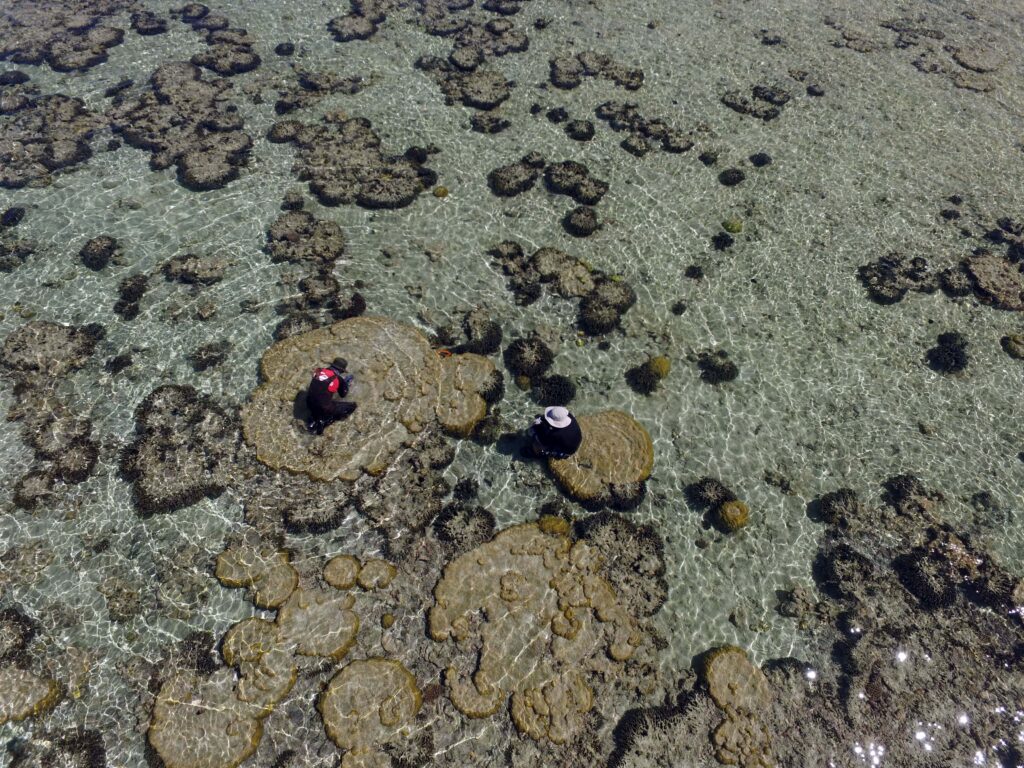
An international team lead by SPP 2299 principle investigator Oliver Knebel from MARUM, University of Bremen has combined fossil and modern Porites corals from Arno Atoll in the Marshall Islands to investigate how Pacific climate variability and coral responses have changed across time intervals of the last roughly 1,500 years. The subseasonally resolved records capture changes in temperature and seawater hydrology alongside coral growth and skeletal density, providing a detailed view of environmental variability and coral calcification.
Different signals reveal different aspects of climate
The oldest coral archive contains two distinct cooling spikes around the sixth century. Their sequence is consistent with two major known volcanic eruptions, providing rare evidence of their climatic imprint in the tropical Pacific.
Remarkably, the volcanic cooling is clearly visible in the coral Sr/Ca-based temperature reconstruction, but not in coral δ¹⁸O measured from the same samples. While Sr/Ca primarily records temperature, δ¹⁸O reflects both temperature and the isotopic composition of seawater. The absence of the cooling signal in δ¹⁸O suggests that a simultaneous shift towards fresher seawater masked the temperature response.
The finding highlights the value of combining different coral proxies: looking at temperature and hydrology together can reveal climate responses that would remain hidden in a single geochemical indicator.
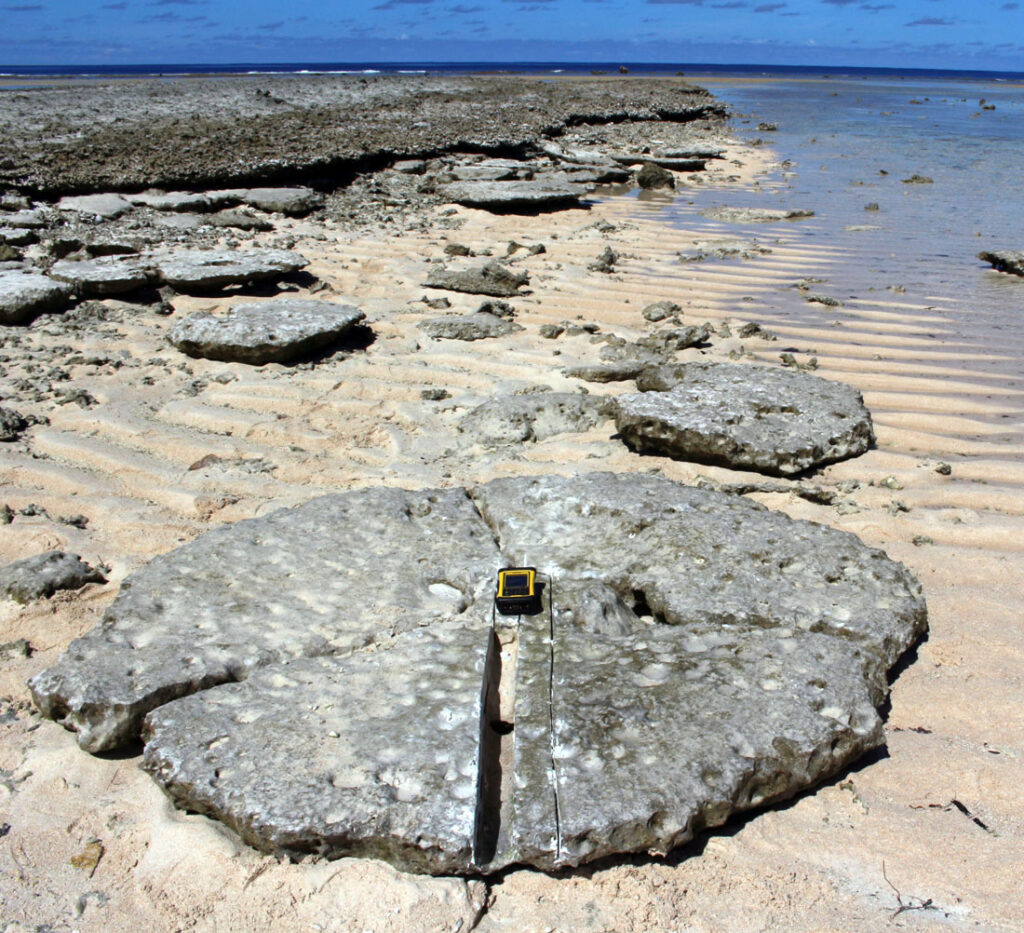
Fossil microatolls at Arno Atoll, Marshall Islands, Western Pacific Ocean. Photo: Eddie Beetham & Paul Kench, University of Auckland
A changing El Niño pattern
The coral archives also provide insights into how ENSO diversity has changed over the Common Era. The Arno records, together with coral records from other regions of the Pacific, suggest that Central Pacific El Niño activity increased between the first and second millennium CE, while Eastern Pacific El Niño activity remained broadly stable.
ENSO occurs in two main flavours, with El Niño events centred either in the Eastern or the Central Pacific. The differing behaviour of the two types highlights that ENSO variability is more complex than a simple increase or decrease in El Niño activity. It also suggests that ENSO variability does not simply mirror changes in global temperature, pointing to a more complex relationship between background climate and El Niño behaviour.
A warmer baseline, a different coral response
The comparison between fossil and modern corals reveals another important change. In the modern coral, temperature anomalies were associated with changes in skeletal density and calcification. Comparable temperature-related effects were not detected in the older fossil corals, which lived under cooler background conditions.
This suggests that the background temperature of the reef matters for how strongly corals respond to short-term thermal variability. The modern coral was already living closer to its upper thermal threshold, making additional temperature anomalies more consequential for calcification.
Combining fossil and modern archives makes it possible to examine climate variability and coral responses across changing environmental conditions—including the transitions occurring during the modern instrumental era.
Together, the coral archives reveal a Pacific climate system in which volcanic disturbances, El Niño variability, hydrological changes and coral calcification do not respond in the same way. Their combination provides a more complete picture of how tropical climate and coral reef ecosystems interact as the background state of the ocean changes.
Research collaboration
This study was carried out within the Deutsche Forschungsgemeinschaft (DFG, German Research Foundation) Priority Programme “Tropical Climate Variability & Coral Reefs” (SPP 2299). Led by principal investigator Oliver Knebel (MARUM, University of Bremen), the study was conducted in close collaboration with researchers from New Zealand and SPP 2299 researchers Diana Diers and Eberhard Gischler from Goethe University Frankfurt, Andrew Dolman from AWI Potsdam, and Thomas Felis from MARUM, University of Bremen.

Oliver Knebel at Arno Atoll, Marshall Islands, Western Pacific Ocean. Photo: Eddie Beetham, University of Auckland
Original publication
Knebel, O., Felis, T., Kölling, M., Kench, P., Eisenhauer, A., Diers, D., Dolman, A. M., Ryan, E., & Gischler, E. (2026). Western Pacific corals reveal Common Era changes in ENSO-diversity, thermal stress, and volcanic cooling. Communications Earth & Environment, 7: 725. https://doi.org/10.1038/s43247-026-03981-3