
This blog is written by Larissa Roy and Jessica Hargreaves, with information from Catarina Martins (Postdoctoral Researcher at Justus Liebig University Giessen).
To most people, coral reefs are colourful paradises scattered across tropical seas. But for researchers like Catarina Martins, they also function as natural laboratories. Catarina and the team, led by PI Maren Ziegler, use these ecosystems to study how climate change affects corals.
Have you ever wondered how scientists recreate climate-change conditions in a lab? Projects like this require careful planning, long hours, and experiments designed to mimic the oceans of the future.
At the Ocean2100 aquarium facility at Justus Liebig University Giessen (JLU), Catarina brings corals into controlled environments to investigate how they respond to heat stress and ocean acidification. The ultimate goal is urgent and clear: understanding why corals are dying.
Who is Catarina Martins?
Catarina Martins is a postdoctoral researcher at Justus Liebig University Giessen, working in the Ocean2100 aquarium facility. Her research is part of the SPP 2299 Programme “DisCoSym,” funded by the German Research Foundation (DFG), focusing on coral calcification and symbiosis under climate-change scenarios. By simulating future ocean conditions in the lab, she studies how reef-building corals cope with rising temperatures and acidifying seas.
How do you recreate climate change in the lab?
In the Ocean2100 facility, corals live under conditions designed to resemble the oceans at the end of this century. Long walls are lined with aquariums hosting miniature oceans, each of which are carefully controlled.
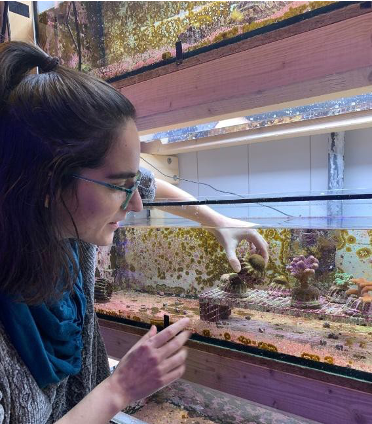
Researchers adjust temperature and pH to create future-like scenarios and observe how corals respond to these controlled changes.
During a heat-stress experiment, for example, corals experience phased temperature increases. Scientists then track how coral growth and physical traits change under these conditions. Buoyant weight measurements reveal calcification rates, while specialised sensors record real-time physiological responses.
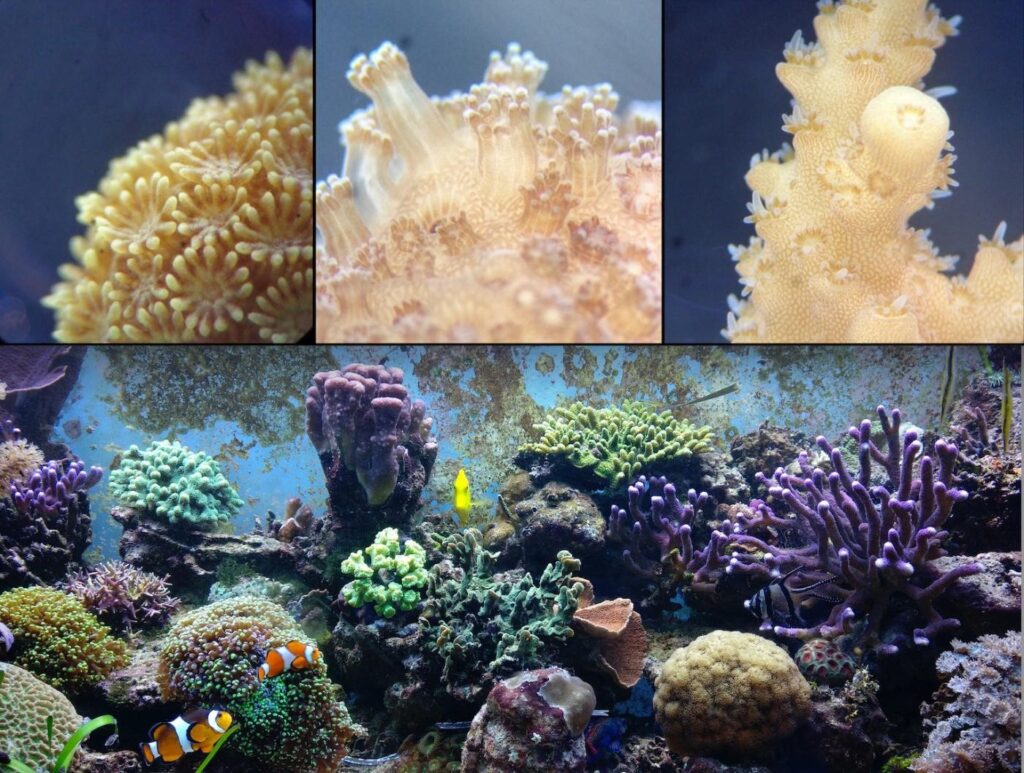
What can we learn from stressed corals?
When corals experience heat stress, they lose their symbiotic algae—a process known as bleaching. To understand how and why bleaching happens, Catarina uses a multiproxy approach, combining several methods that highlight different aspects of coral health:
- Tracking growth rates using buoyant weight
- Analyzing changes in coral tissue and skeleton
- Using high-resolution imaging to detect subtle structural shifts
Together, these methods reveal how corals respond physiologically to extreme conditions and whether they show signs of resilience or adaptation to simulated climate-change scenarios.
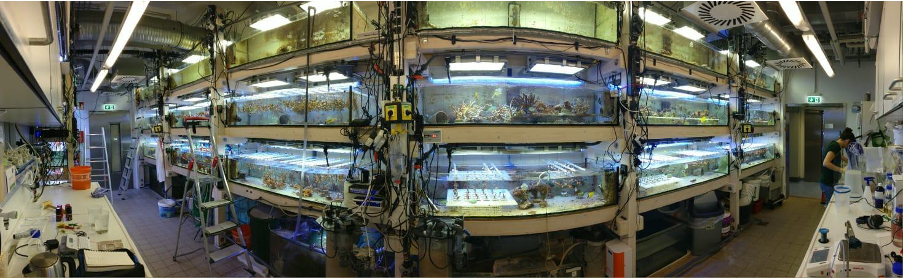
Why does this work matter?
Coral reefs protect coastlines, support fisheries, and host extraordinary biodiversity. Yet rising ocean temperatures and increasing ocean acidification threaten their future.
Catarina’s experiments do more than document stress responses—they help identify which corals may be more resilient and which are more vulnerable. This knowledge is essential for predicting how reefs may change in the coming decades and for guiding conservation strategies that enhance their long-term survival.
Supported by the DFG
Catarina’s research is part of the interdisciplinary SPP 2299 Programme, funded by the German Research Foundation (DFG). She highlights how crucial this support has been for providing the infrastructure, collaboration opportunities, and research environment needed to advance coral-reef science.
“Each experiment brings us closer to understanding how corals might endure the challenges ahead. It’s exciting to be part of this effort,”
Catarina Martins
To follow Catarina and her colleagues’ work, visit @climatereefs on Instagram, where researchers share stories, images, and updates from both the lab and the field.