CorCliV2 addresses a long-standing puzzle in tropical paleoclimatology. Reconstructions of sea surface temperature (SST) from coral Sr/Ca and δ¹⁸O records appear to show much more decadal-to-centennial variability than either climate models simulate or the instrumental record contains. Either climate models underestimate slow tropical variability, or coral records contain unrecognised non-climatic noise that masquerades as a climate signal.
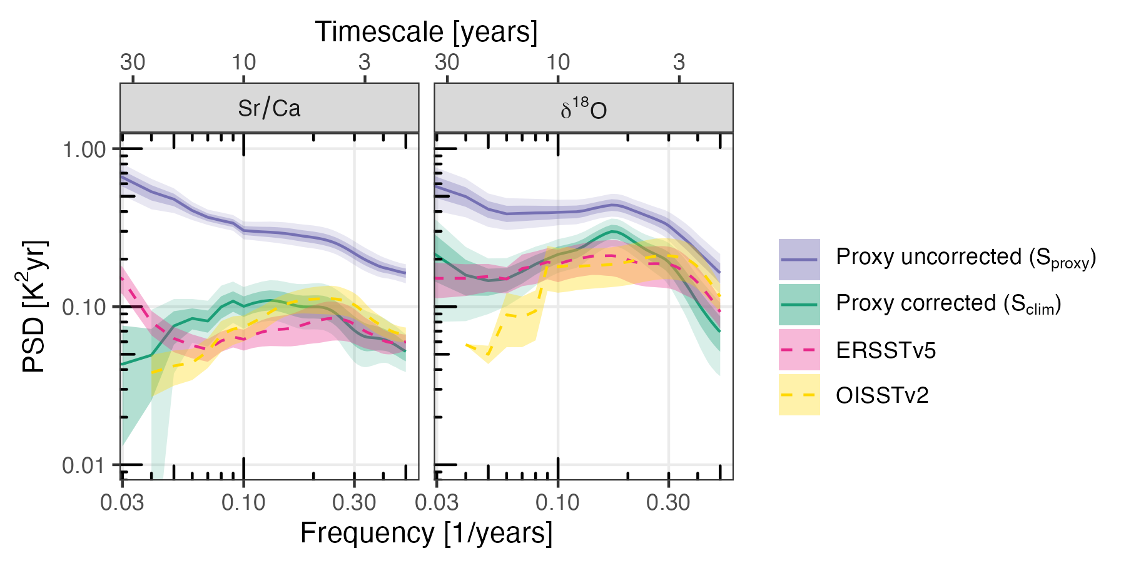
In phase 1 of CorCliV, we showed that the temperature sensitivity of coral Sr/Ca and δ¹⁸O is not, as previously thought, timescale dependent. Instead, by comparing pairs of records from colonies growing only metres to a few kilometres apart, we found that individual records contain a large, strongly autocorrelated, non-climate noise component. After accounting for this noise, the corrected coral spectra agree, within uncertainty, with both satellite (OISSTv2) and reanalysis (ERSSTv5) SST. Uncorrected records inflate decadal-to-centennial variance by factors of two to seven.
CorCliV2 will (i) develop a mechanistic understanding of the autocorrelated noise, including the role of “wandering vital effects”, slow drifts in coral physiology that shift the chemistry-to-temperature relationship over time, and identify covariates that can detect and correct these shifts; (ii) implement a frequency-domain proxy-system model for coral Sr/Ca and δ¹⁸O combining bio-smoothing with the autocorrelated noise term, fitted to individual records to retrieve corrected climate signals; and (iii) provide guidance for future coral campaigns on sampling design, replication, and site selection.
Using these corrected reconstructions, we will produce revised estimates of pre-industrial multi-decadal tropical SST variability and place the recent decades of Pacific warming and cooling in a robust paleo-context. We will then test whether climate models still underestimate internal tropical variability, and explore the potential of corrected coral records as emergent constraints on tropical feedbacks shaping observed and projected warming.
Principle Investigator