The focus of the project ExtTroPact is on the imprint of specific external forcings (orbital, volcanic) on tropical climate variability in Earth System model simulations carried out by the fourth phase of the Paleoclimate Intercomparison Project (PMIP4) and newly created simulations in the context of the paleo-storyline approach for different periods of the late Quaternary.
This is achieved e.g. by disentangling the spatial fingerprint of the various forcing factors for different climatic background conditions (Last Interglacial (LIG 127 k), Last Glacial Maximum (LGM 21 k), mid-Holocene, last millennium) over the tropical regions in the first part of the project. An important part will be on a consistent evaluation on how different climatic background conditions of the late Quaternary influenced the three tropical ocean basins and according modes of variability related to the El-Nino Southern Oscillation, the Indian Ocean Dipole and Atlantic tropical variability.
A second part of the project is on new paleo-storyline simulations that will address questions focusing on extreme events, being of relevance for present and future climate change. In this context a new setup with the ICON-O ocean model with increased coastal resolution on an irregular grid over the Andaman region will be used. Additional storyline simulations will be carried out for volcanic events to test the response of the high resolved ICON-O ocean model on cold climate states and specific El Nino conditions during the last millennium. These results will be compared with modelling and empirical results of other SPP projects.
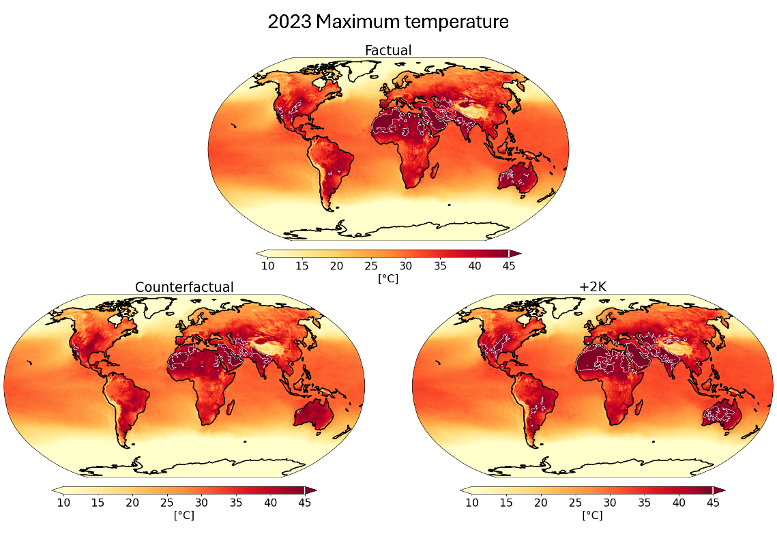
The last part of the project is on setting up pseudo proxy experiments with PMIP4 simulations, the newly created paleo-storyline simulations and global and regional simulations of two other SPP projects. The pseudo proxy experiments will use the coral sites in the real world and results of the numerical simulations will be used to test hemispheric and regional setups. This will help to assess the quality of the methods used for empirical reconstructions and allows to test whether coral proxy networks used for climate field reconstructions trained with current observational data can be used for inferences on past climate and environmental states of the late Quaternary.
Principle Investigator
Sebastian Wagner (Helmholtz-Zentrum Hereon, Geesthacht) – PI
Frauke Feser (Helmholtz-Zentrum Hereon, Geesthacht) – Co-PI
Project Scientist
N.N.
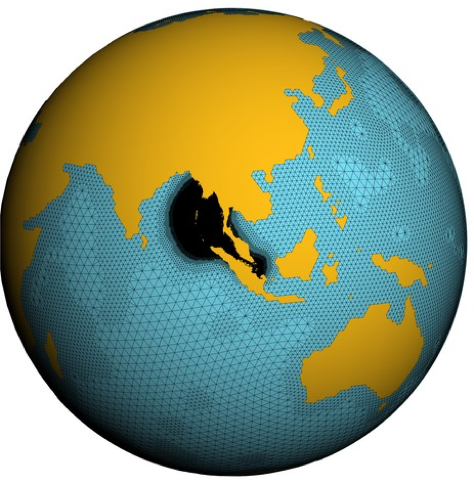
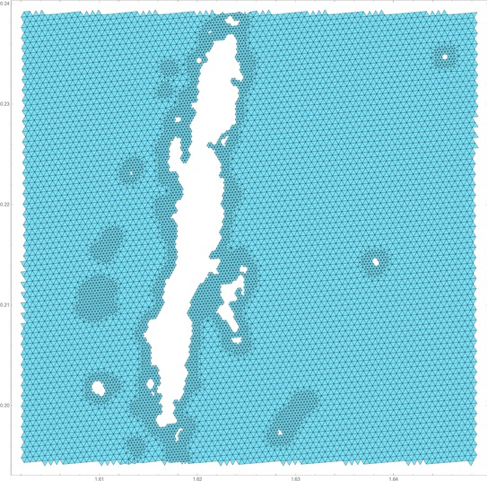
Regional view of the Andaman Sea
The structure of the irregular grid used in ICON-O with increased resolution in the Andaman sea.
Left: Hemispheric view of the South-East Asian region with a coarse grid (approx. 160 km) outside the target region. Right: Sample region of the Andaman sea with a horizontal resolution of 1 km along the coasts. (Courtesy by K. Logemann, Hereon).