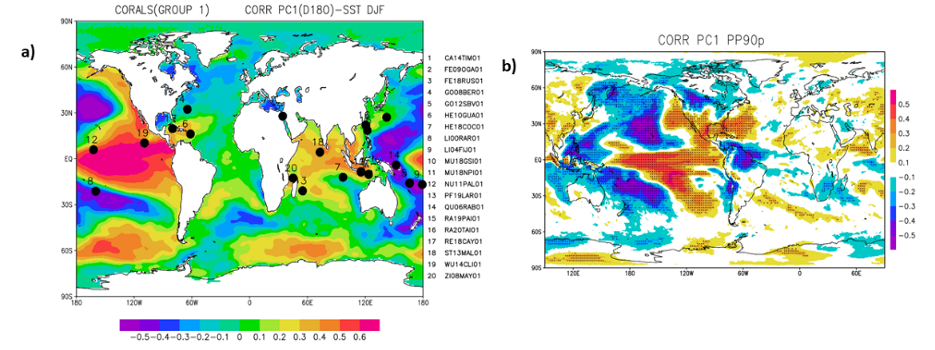
Rising global average temperature is associated with widespread changes in weather and climate patterns. A significant increase in the frequency and intensity of extreme weather events such as heat waves, droughts, floods and storm surges, among others, partly related to human-induced climate change, is recorded during the last decades. To better assess the recent changes in climate and weather extremes we need to put them into a long-term perspective using proxy data and climate model simulations. Tropical and subtropical corals are commonly used to reconstruct seasonal, annual or decadal climate anomalies in the extratropical region via tropical-extratropical teleconnection patterns. Recent studies showed a strong link between tropical climate anomalies and synoptic scale atmospheric circulation patterns associated with weather extremes in the extratropical region. The existence of such links provides the possibility to use tropical and subtropical corals to reconstruct part of the interannual to multidecadal variability of weather and climate extremes in the extratropical region. As an example, we show the correlation maps between the first principal component time series (PC1) of the coral δ18O records belonging to Group 1 of the CoralHydro2k database and winter mean sea surface temperature (SST) and frequency of extreme precipitation days (PP90p index) for the observational period of the winter (DJF) season. The overall objective of this project is to evaluate the potential of corals to record mid-latitude extreme weather variability as well as to understand how changes in mid-latitude extremes in future climate could impact the coral growth environment.