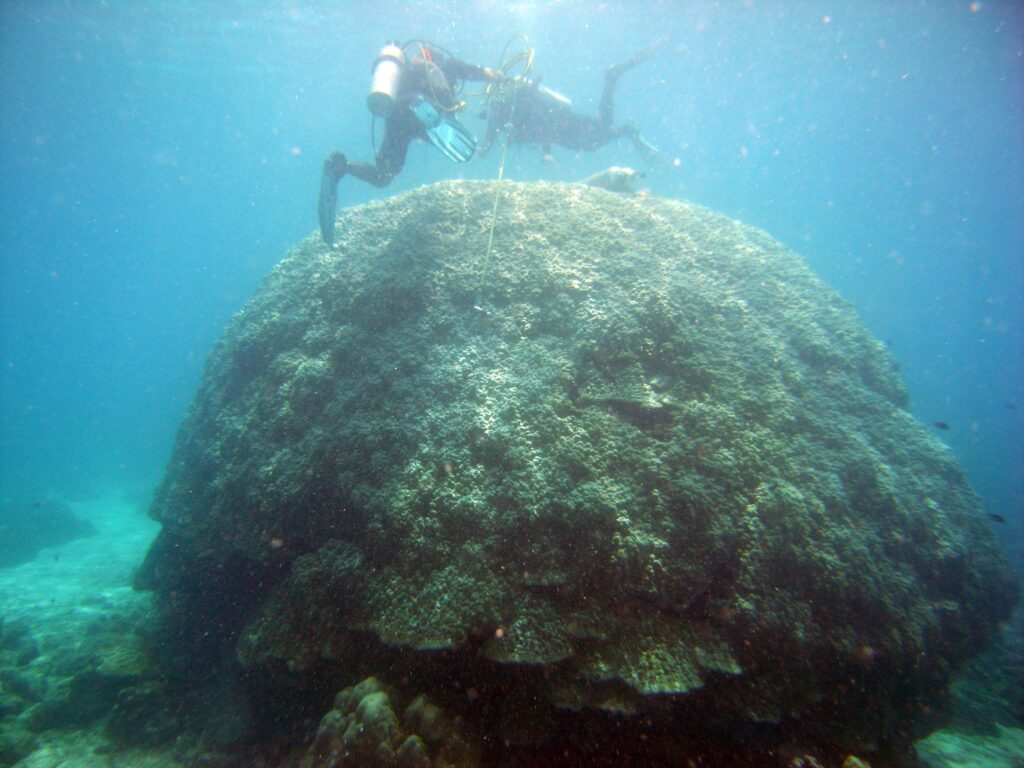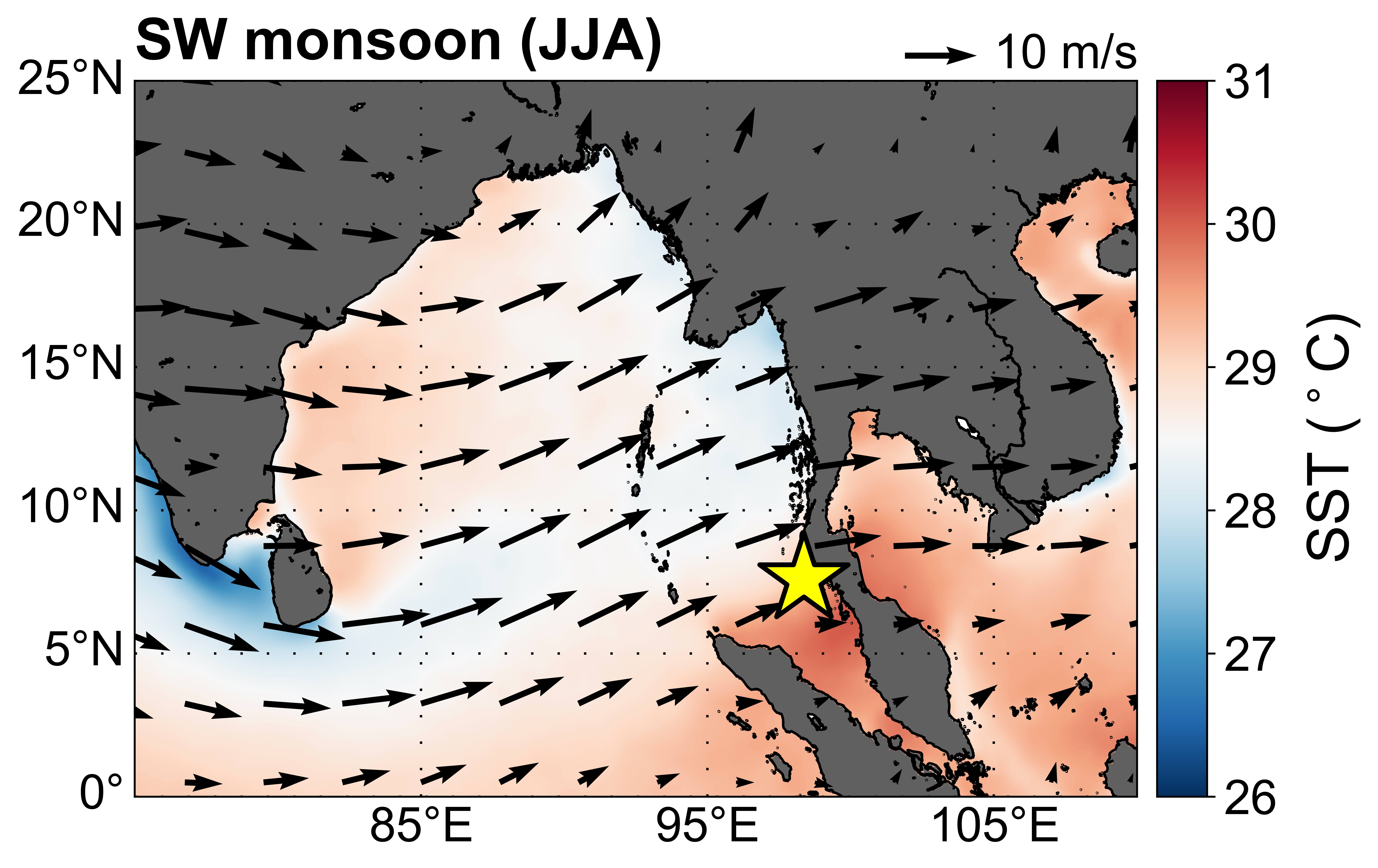
The IndOC-E II project contributes towards a better understanding of tropical marine climate variability and its impact on coral reef ecosystems in a warming world, by quantifying climatic and environmental changes during the warming from the pre-instrumental period to the early 21st century on timescales relevant for society. These are major aims of the Priority Programme “Tropical Climate Variability & Coral Reefs” (SPP 2299). The project reconstructs marine climate and environmental change in the northeastern Indian Ocean since the late Little Ice Age at ultra-high resolution, by analysing isotopic and geochemical proxies in shallow-water coral skeletons. The project generates reconstructions of sea surface temperature, hydrology (hydroclimate), and coral response to thermal stress back to the early 1800s at monthly resolution from Porites corals of the southern Andaman Sea (Thailand). In a previous project phase (IndOC-E), a site not strongly affected by marine heatwaves because of the mitigating effect of cooling by internal waves provided proxy records of sea surface temperature, hydrology (hydroclimate), Indian Ocean Dipole events and volcanic eruptions back to the year 1774, based on paired measurements of Sr/Ca and oxygen isotopes.
In the current project phase (IndOC-E II), another site experiencing the unabated influence of marine heatwaves is studied in detail to provide a proxy record of coral response to thermal stress events back to the early 1800s, based on anomalous signatures in measurements of Sr/Ca, oxygen isotopes, Mg/Ca, stable carbon isotopes, and growth patterns. The history of stress response of a centuries-old coral colony that died in 2010 during one of the most severe coral bleaching events on record in the Andaman Sea will be investigated, and set into context with the local thermal history derived in the previous project phase from a different colony not strongly affected by marine heatwaves that survived this event.
The reconstructions will enable to study the interplay of different El Niño flavours, the Indian Ocean Dipole, volcanic eruptions, and large amplitude internal waves in modulating variability and extremes of Andaman Sea temperatures and hydrology since the late Little Ice Age, with implications for coral growth and resilience. The reconstructions will enable to explore if Andaman Sea corals were exposed to thermal stress events during past centuries and if environmental memory, resulting from extreme northeastern Indian Ocean warmings of the past such as the very strong 1877/78 El Niño event, lead to higher temperature tolerance during thermally-induced stress events of recent decades.
Principle Investigator
Thomas Felis (MARUM, University of Bremen)
Project Scientist
Hana Camelia (MARUM, University of Bremen)