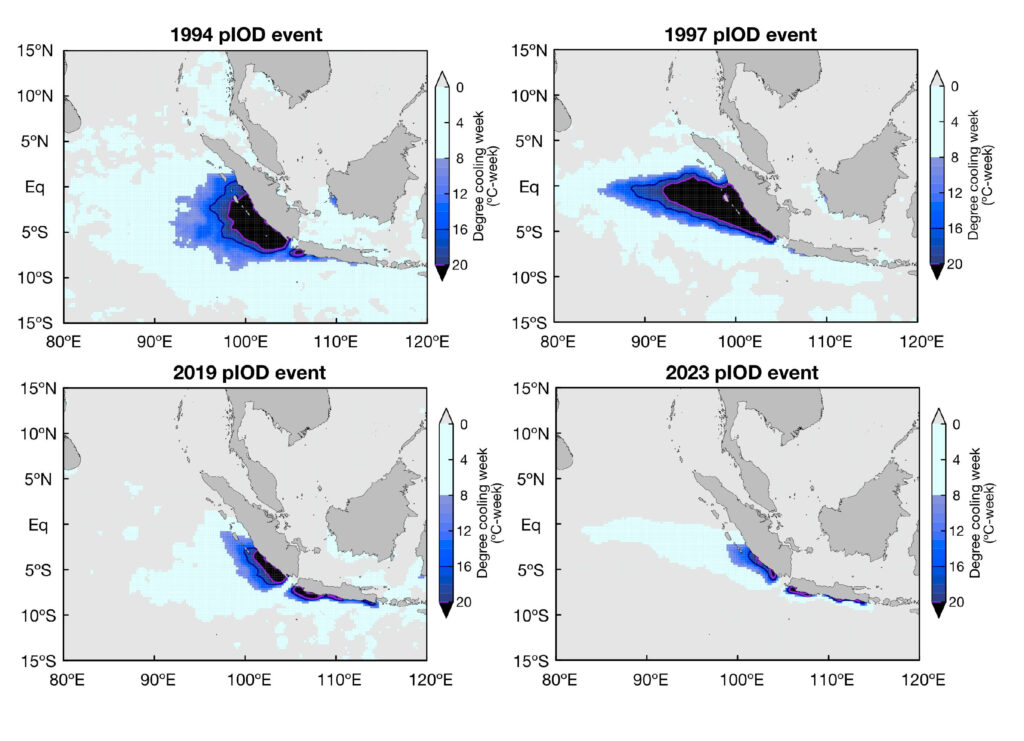
Corals expanding to higher latitudes may be impacted by cold winter temperatures. It is therefore important to understand the corals’ ability to acclimatize to cold temperatures in a warming world. However, cold water coral bleaching is not yet included in the stress metrics provided by NOAA’s coral reef watch. Observations indicate that cold water bleaching can be predicted by the same sea surface temperature (SST) metrics as warm water bleaching (with opposite sign): SST anomalies -1°C below the minimum monthly mean SST accumulated over a 12-week period (‘Degree Cooling Weeks’, DCW) appear to be related to the intensity of cold-water bleaching. The Java-Sumatra coast offers a natural laboratory to study the stress response of corals to DCW and their acclimatization. Coastal upwelling causes seasonal cooling off Java, frequent cold events off southern Sumatra, while infrequent cold events reach the equator during extreme positive Indian Ocean Dipole (IOD) events.
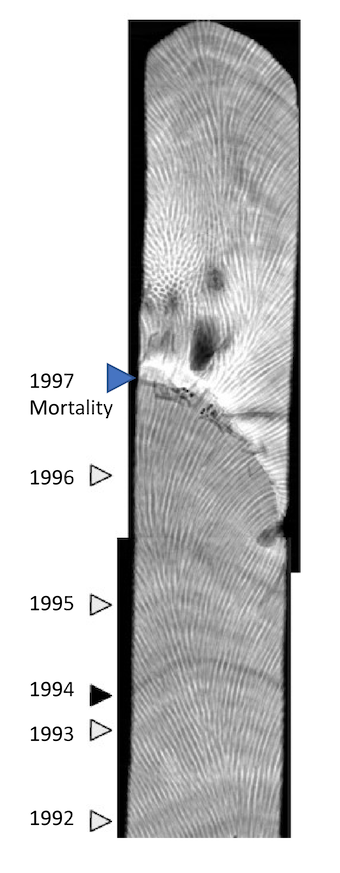
We aim to collect cores from massive Porites corals spanning the satellite period (1985-present) from three sites along the coasts of Java and Sumatra in order to compare cores from a site with infrequent strong upwelling events with cores from a site with seasonal upwelling, plus one an intermediate site. Cores will be CT scanned to reveal stress bands or mortality scars. Non-destructive SEM imaging of coral slabs will be used to investigate coral growth, stress bands and mortality scars in detail. Sr/Ca analysis will be performed on selected cores, combining conventional solution ICP-OES with novel laser ablation ICP-OES analysis recently developed at CAU Kiel. Ultra-high-resolution laser ablation-ICP-OES analysis of Sr/Ca will help to constrain when coral growth was impeded, resulting in a stress band or a mortality scar. The duration of growth interruption along mortality scars will be further constrained by combining Sr/Ca data with U-Th dating. Laser ablation inductively coupled mass spectrometry (LA-ICP-MS) will be used to measure trace element/Ca ratios such as Mn/Ca and Ba/Ca as proxies for nutrient input from wildfires or upwelling, respectively, complemented by stable isotope analysis (δ13C and δ18O). Geochemical proxy data will be corroborated by seawater analysis and in situ loggers.
With this toolbox, we aim to retrospectively monitor coral stress driven by IOD induced upwelling, including cooling and nutrient enrichment. Cold stress is not yet systematically monitored and its effects may be misattributed to local pollution. DCW calculated from high resolution satellite and coral proxy data will be used to assess the interplay between minimum monthly mean SSTs and the frequency and relative intensity of cold events driven by the IOD, and their impact on coral growth. Results will have implications for coral reef conservation off Java and Sumatra, as positive IOD events are projected to increase with global warming.
Principle Investigator
Miriam Pfeiffer (Kiel University (CAU))
in cooperation with:
Sri Yudawati Cahyarini (National Research and Innovation Agency (BRIN), Indonesia)
Project Scientist
N.N.