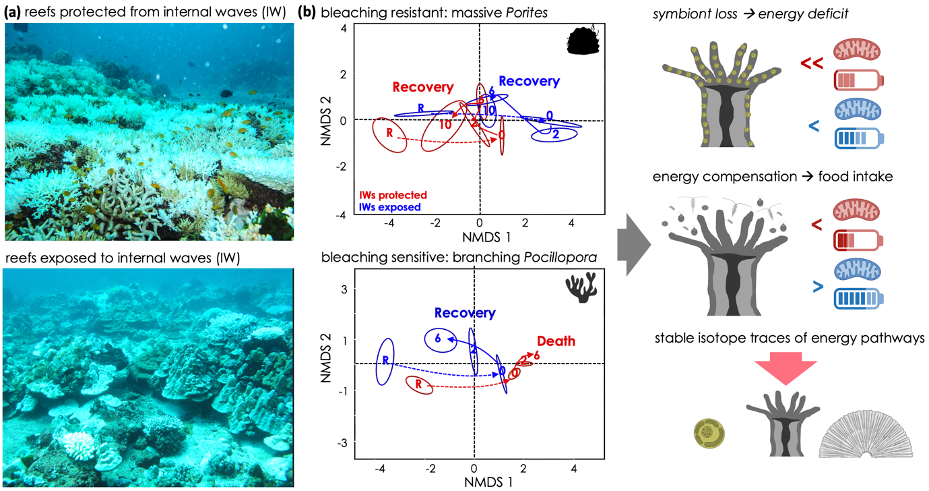
Coral reefs are characterized by high biodiversity, but they are under serious threat of decline. This has led to research on “climate refugia,” such as reefs influenced by deep water upwelling, where cold water can reduce heat stress, bleaching, and the loss of coral species. This project investigates whether cold-water upwelling events induced by internal waves also provide nutritional benefits that boost coral resilience, particularly during heatwaves. It builds on previous projects that form a solid foundation for the work (e.g., ReefCPTrace during SPP2299 Phase 1, international training network – Calmaro, DFG project – Ocean reef coupling in the Andaman Sea). The project will complement previous work through more in-depth investigations of energy pathways in reef corals under the influence of internal wave upwelling and/or during heatwaves. Previous studies have shown that the upwelling of deep, cold water can mitigate warming during heat waves and protect corals from bleaching. However, it is less well known whether the transport of nutrient- and particle-rich water also provides corals with additional energy, which they can use to replenish their energy reserves through heterotrophic feeding when the energy supply from symbionts is reduced or completely absent. Using internal-wave-exposed and -sheltered reefs in the Andaman Sea and coral samples from the 2010 heatwave, the study investigates whether increased food intake can be detected in the corals from internal-wave-exposed reefs. It is expected that a loss of symbionts combined with increased food intake will modulate the stable isotope signal in coral tissue, which is assumed to leave detectable traces at the level of the coral skeleton as well. Furthermore, experiments simulating bleaching will help verify the underlying mechanisms. The project aims to decipher the relative contribution of reduced energy due to the loss of symbionts and energy gain through increased food intake to the changes in stable isotope signals. Together, these investigations will provide insights into how bleaching and food supply manifest in the coral skeleton’s signal and whether these can be used to reflect changes in energy balance.