
The ocean is a vast archive of Earth’s climate history—but much of it remains hidden in plain sight. Climate and coral scientists rely on subtle chemical signals preserved in marine environments to reconstruct how the climate system has changed over time. One of the most powerful of these signals is seawater oxygen isotopes, commonly expressed as δ¹⁸O.
In the recent publication, “The PAGES CoralHydro2k Seawater δ¹⁸O Database: a FAIR-aligned compilation of seawater δ¹⁸O data to uncover ‘hidden’ insights from the global ocean”, a team of international scientists brought together decades of scattered measurements into a single, accessible, and standardized resource. At the center of this effort is the PAGES CoralHydro2k Seawater δ¹⁸O Database, a critical tool for understanding how the global water cycle is evolving under ongoing climate change.
Among the contributors to the compilation are SPP 2299 researchers Jessica Hargreaves and Thomas Felis of the Phase 1 Coordination Team at MARUM, University of Bremen, who helped assemble and harmonize the seawater δ¹⁸O measurements that form the foundation of the database.
Why δ¹⁸O Matters
Seawater δ¹⁸O is a sensitive tracer of the hydrological cycle, reflecting the balance between evaporation, precipitation, runoff, and ocean circulation. Because these processes respond directly to rising temperatures, δ¹⁸O provides key insights into how the global hydrological cycle intensifies as the planet warms.
Corals archive these signals in their skeletons, offering records of past ocean conditions that extend back centuries. Interpreting these records, however, requires a clear understanding of seawater δ¹⁸O itself—something that is now far better constrained thanks to the PAGES CoralHydro2k Seawater δ¹⁸O Database.
From Fragmented Data to Global Insight
For years, seawater δ¹⁸O measurements have been widely available but difficult to use, scattered across studies and stored in inconsistent formats. Earlier efforts, such as the NASA GISS seawater δ¹⁸O database, provided an important foundation for the community, but have not been updated since 2011.
Since then, significant advances in analytical techniques over the past 15 years have led to a rapid increase in the quantity and quality of seawater δ¹⁸O measurements. Until now, however, many of these newer data remained dispersed and underutilized. By compiling and standardizing both legacy and newly generated measurements, the PAGES CoralHydro2k Seawater δ¹⁸O Database creates a comprehensive, up-to-date global archive.
“The PAGES CoralHydro2k Seawater Database initiative led by Alyssa Atwood from Florida State University is a substantial milestone for the marine global change community, and provides another great example of long-term international collaboration involving volunteer scientists from all academic levels, working remotely across virtual platforms,” says SPP 2299 Phase 1 Coordinator Thomas Felis from MARUM, University of Bremen, who initiated the CoralHydro2k project within the framework of the PAGES 2k Network in 2017.
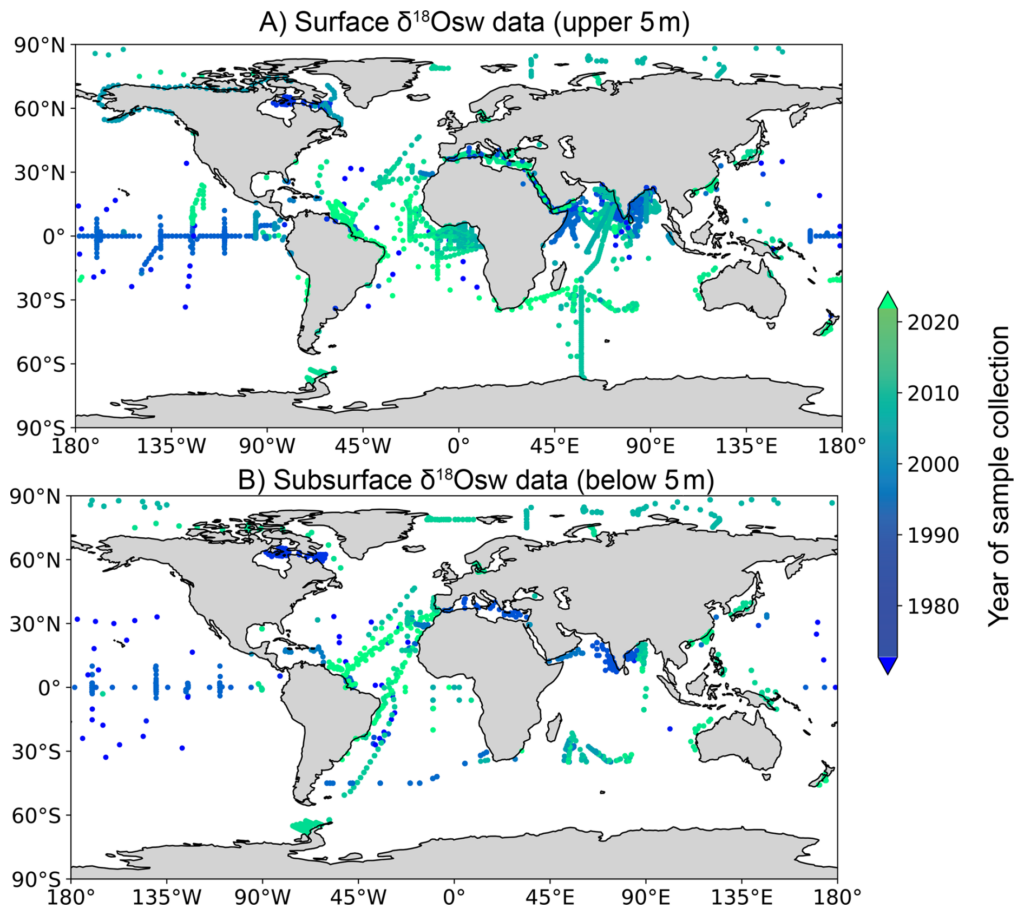
Sample collection years of the seawater δ18O data in the database from (A) the surface ocean (upper 5 m) and (B) the subsurface ocean (below 5 m). Atwood et al., Earth System Science Data (2026).
Why This Matters Now
As global warming accelerates, the hydrological cycle is intensifying, reshaping patterns of evaporation, precipitation, and ocean salinity. Understanding these changes is essential for predicting future climate dynamics.
The PAGES CoralHydro2k Seawater δ¹⁸O Database provides the observational foundation needed to track these shifts with unprecedented coverage and consistency. It also offers a much-needed benchmark for climate models, helping to improve simulations of the water cycle—one of the most uncertain components of the climate system.
Looking Ahead
Developed by a team of international scientists, the PAGES CoralHydro2k Seawater δ¹⁸O Database is designed as a living resource that will continue to grow with new data and applications.
By bringing together decades of measurements—including many generated in recent years—this effort opens new possibilities for understanding how the ocean and the global hydrological cycle are responding to continued warming. Ultimately, it provides a powerful tool to better understand the past, track the present, and anticipate the future of our changing climate.
Original publication:
Atwood, A. R., Moore, A .L., DeLong, K. L., Long, S. E., Sanchez, S. C., Hargreaves, J. A., Morris, C. A., Pauly, R. E., Dassié, É. P., Felis, T., Voelker, A. H. L., Murty, S. A., & Cobb, K. M. (2026). The PAGES CoralHydro2k Seawater δ18O Database: a FAIR-aligned compilation of seawater δ18O data to uncover “hidden” insights from the global ocean. Earth System Science Data, 18: 1921–1941. https://doi.org/10.5194/essd-18-1921-2026
Further Information:
The PAGES CoralHydro2k Seawater δ¹⁸O Database is available at: https://doi.org/10.25921/ap7d-2k16
Example Jupyter notebooks and MATLAB scripts are available at: https://github.com/CoralHydro2k/ch2kSeawater_Database and https://doi.org/10.5281/zenodo.18828491
New seawater δ¹⁸O data can be submitted at: https://www.earthchem.org/communities/seawater-oxygen-isotopes/