The Marine Isotope Stage 5e period (~125,000 years ago; MIS 5e), also known as the Last Interglacial (LIG), represents the most recent interval in Earth’s history when global mean temperatures were approximately 1–2 °C higher than pre-industrial levels and sea level stood several metres above present. Because these conditions resemble those projected for the coming decades, the LIG provides a natural benchmark for understanding the functioning of tropical oceans in a warmer-than-present world. Despite its relevance, however, high-resolution tropical marine records from this period remain extremely scarce. Most existing archives, such as marine sediments and ice cores, lack the temporal resolution required to resolve seasonal cycles, interannual variability, and short-lived extremes such as marine heatwaves. This represents a critical knowledge gap in assessing how coral reef ecosystems respond to sustained warmth and climate variability.
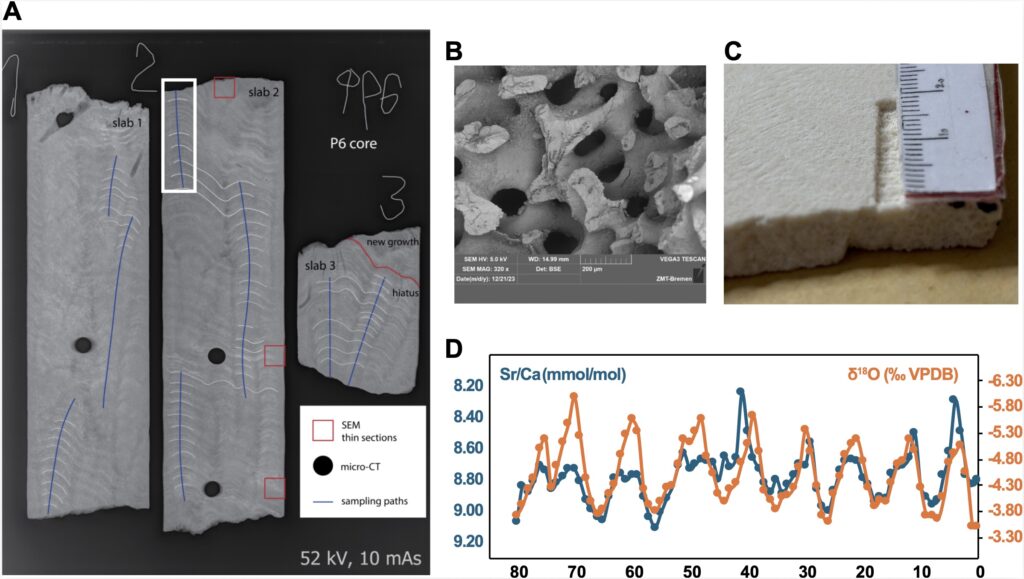
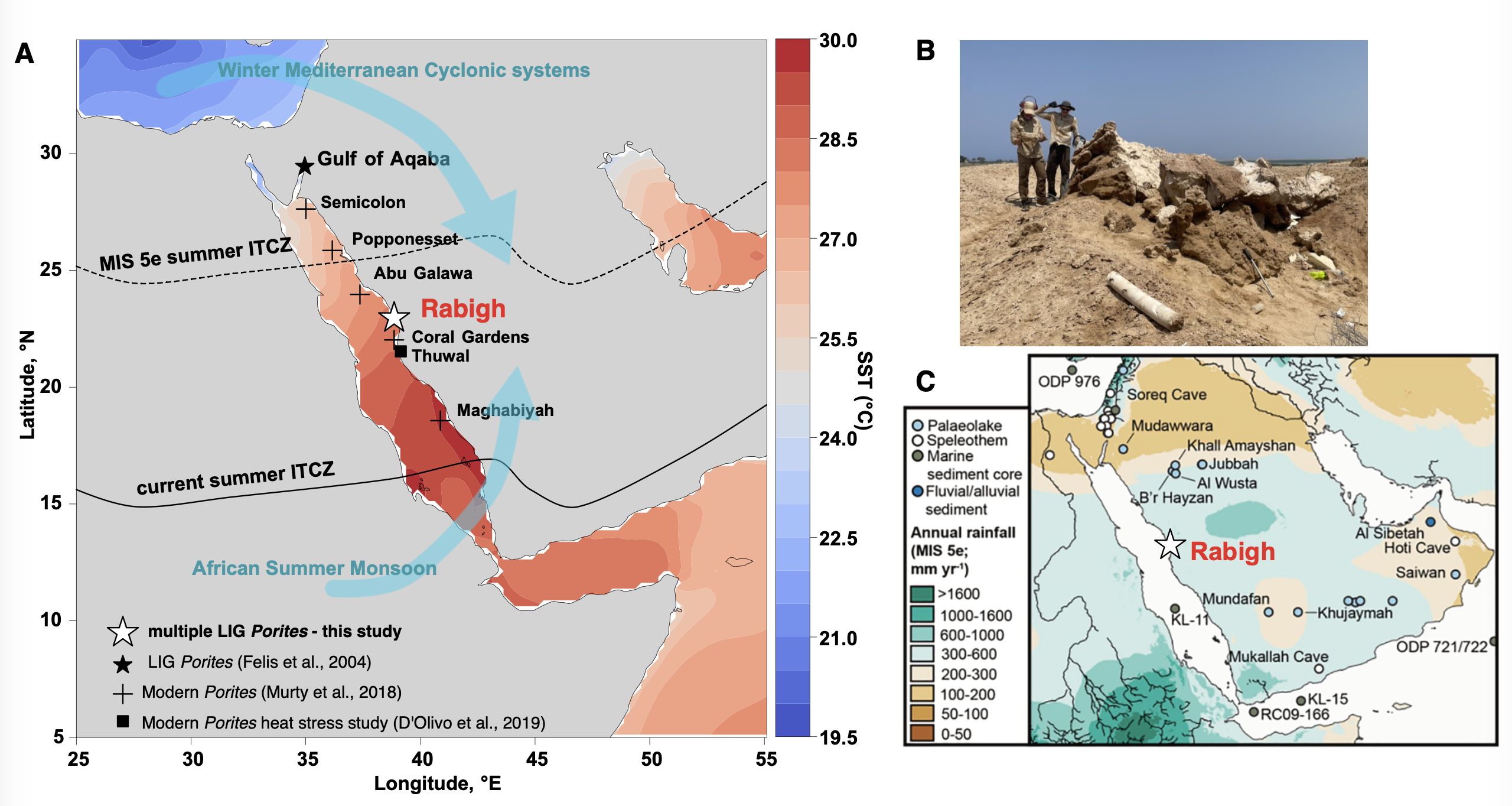
This project addresses that gap using exceptionally well-preserved fossil Porites corals from the central Red Sea, a semi-enclosed basin characterized by high temperatures, high salinity, and strong evaporation. Coral skeletons grow continuously and record environmental conditions at high temporal resolution, making them unique archives of past ocean variability. By analysing paired isotopic and trace element proxies, the project will provide monthly to annual sea surface temperature (δ¹⁸O, Sr/Ca, Li/Mg), hydroclimate variability (δ¹⁸Osw), extreme events (Mg/Ca, δ¹3C, growth parameters) and seawater carbonate chemistry (B/Ca, U/Ca, δ¹¹B) reconstructions. These centennial-scale multiproxy records will enable quantification of seasonality, detection of interannual to interdecadal variability, and identification of anomalous thermal-stress signatures preserved in coral growth and skeletal geochemistry.
The Red Sea is particularly well suited for this investigation because its corals are among the most heat-tolerant globally and already live close to their upper thermal thresholds. Reconstructing variability and extremes during a naturally warm climatic interval provides a crucial baseline for determining whether modern marine heatwaves and bleaching events exceed natural variability or represent fundamentally novel conditions. Furthermore, integrating coral-based reconstructions with transient coupled climate-model simulations of the LIG and modern observational datasets will improve constraints on model performance and clarify how natural warm-period variability differs from today’s rapid anthropogenic warming. These insights have important implications for evaluating the long-term stability, resilience, and future vulnerability of coral reef ecosystems under continued climate change.
Principle Investigator
Project Scientist
N.N.