
Many people dream of becoming a researcher and discovering new ways to explore the oceans. But few people realise what that actually looks like. If you are curious about what it’s like to be a researcher, you are at the right place.
Being a researcher is to be a project manager, a data collector, a data analyst, an artist (to some degree), an inventor, and a dreamer, all to answer questions no one has answered yet. Research combines teamwork, hands-on lab work, and the challenge of learning to understand what the data is telling you.
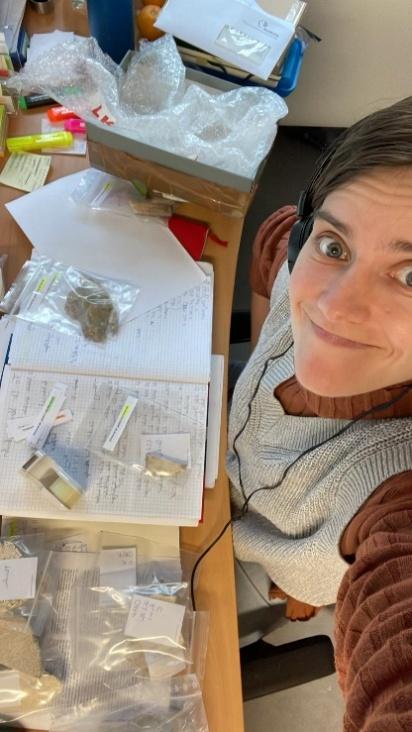
Today, you will meet Luisa Meritiz, a PhD researcher in the SPP 2299 programme who has turned that dream into a reality. She has already travelled over 30,000 kilometres across the Atlantic Ocean to answer the questions surrounding fossilised corals. Get to know her and her drive for scientific research!
Blog written by Larissa Roy and Jessica Hargreaves, with information from Luisa Meiritz (PhD Researcher at the GEOMAR in Kiel).
So, who is Luisa Meiritz?
She is an early-career researcher who completed her master’s thesis at the University of Hamburg in 2021. Since July 2022, she has been a PhD candidate at GEOMAR Helmholtz Centre for Ocean Research Kiel in the working group for Paleoceanography led by Martin Frank.
Her doctoral project is part of the SPP 2299 EPIBleach project, supervised by Eleni Anagnostou and Jan Fietzke. Her research focuses on developing geochemical and physical tracers of coral bleaching. By studying both modern and fossil corals, Luisa aims to understand how corals responded to heat stress in the past—and what that might mean for their future.
To do this, she uses a range of advanced techniques, including microprobe analysis, amino acid measurements, X-ray diffraction, and image analysis.
How do researchers study something as complex as coral bleaching in the lab?
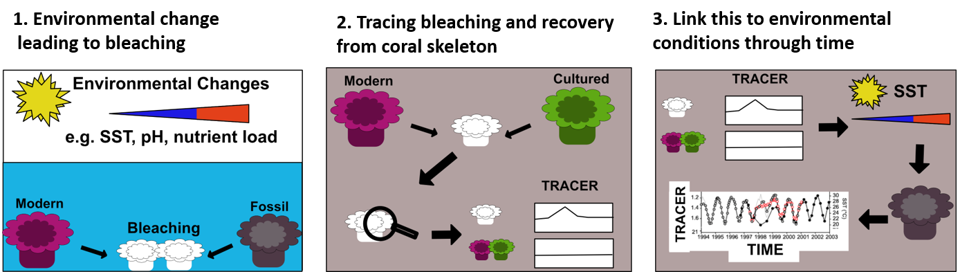
Within the EPIBleach project—short for Reconstructing ultra-high-resolution climate variability and symbiont bleaching in tropical corals: from past to present—Luisa works to decode signals preserved in coral skeletons.
The goal is to identify reliable geochemical or physical tracers of coral bleaching in modern coral skeletons. Once established, these tracers can be applied to fossil corals from warmer periods in Earth’s history, helping scientists detect bleaching events and potential coral adaptations in the past.
To do this, Luisa uses a multi-proxy approach, which means combining different measurement methods to get a detailed picture of how corals respond to heat stress. One key focus is understanding how coral skeleton composition changes during bleaching events. In some cases, bleached corals may even look different under a microscope.
For example, a microprobe—an electron microscope equipped with mass spectrometers—allows her to map how chemical elements are distributed across coral skeletons. She also works with a µCT scanner, which reveals density changes in coral skeletons at an astonishing resolution of just 47 micrometres.
Each method adds another piece to the puzzle.
So, how do we actually analyze coral skeletons?
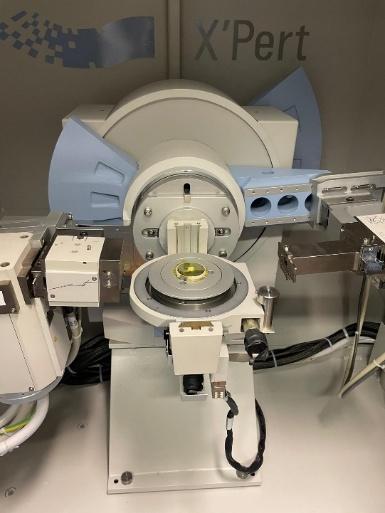
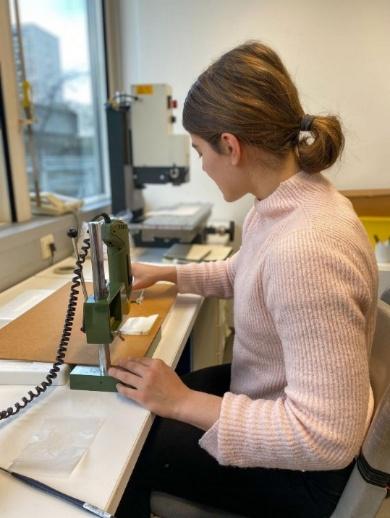
The first method is X-ray diffraction (XRD), shown in the left image. This technique is used to examine the crystal structure of powdered coral skeletons. In the right image, Luisa is drilling coral powder from a modern coral sample, which she can analyse using typical methods in the SPP 2299, gaining a full picture of geochemical signals.
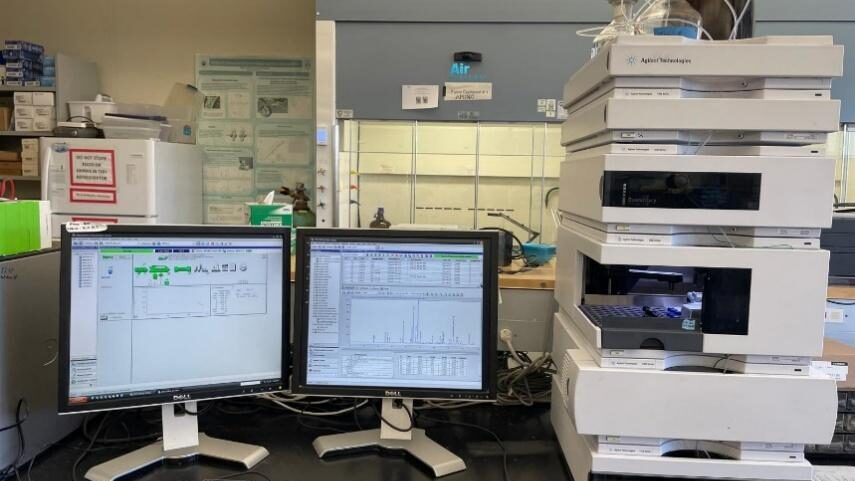
The second approach focuses on the organic matter between the coral skeleton crystals. This is analysed using an amino acid analyser (shown below). Luisa was awarded an Early Career Researcher Mobility scholarship from the SPP 2299 to conduct this analysis, which she conducted at the University of Hamburg and at the Northern Arizona University during 2025.
Why are fossil corals important for understanding today’s ocean problems?
Fossil corals archive the ocean’s history. They record changes in temperature, chemistry, and events like bleaching. In her research, Luisa looks at corals from warmer periods in Earth’s past to see how they reacted to heat stress. This helps answer a critical question: Can corals adapt to warming oceans—or is today’s climate change happening too fast for them to keep up?
Conducting this work—from drilling fossil samples to analysing them in high-tech laboratories—requires not only expertise, but also strong scientific infrastructure and funding.
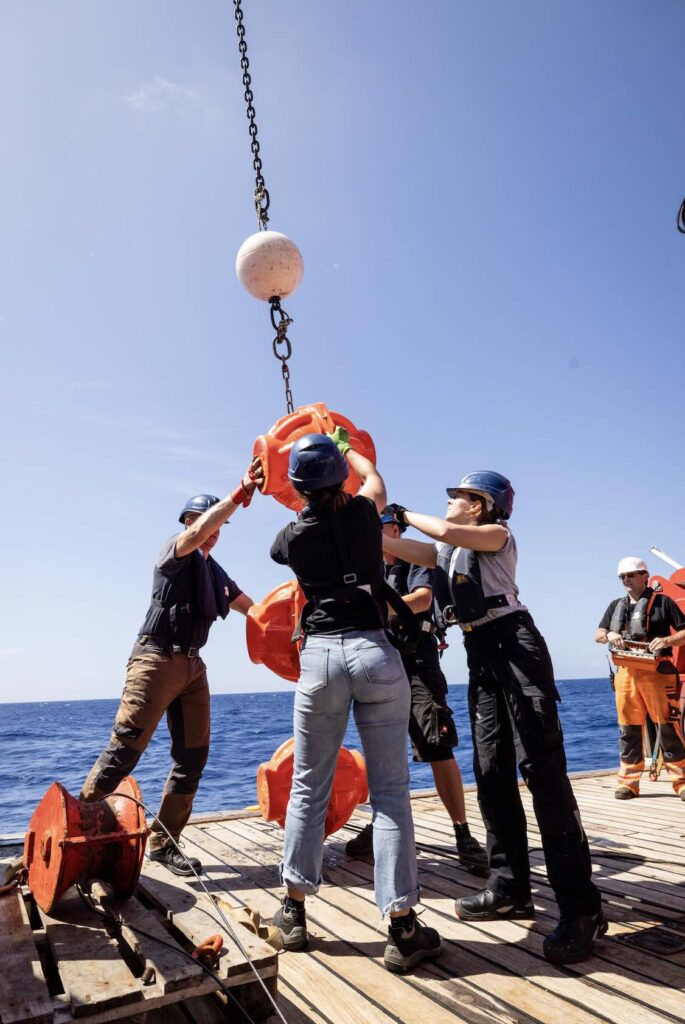
But honestly, what is it like to spend months at sea?
Between 2018 and 2024, Luisa Meiritz joined six major research expeditions aboard German vessels like the RV Sonne, RV Meteor, and RV Heincke. Working with teams from the Universities of Hamburg and Bremen, she covered over 30,000 kilometres across the Atlantic and Indian Oceans, from the German Bight to the Benguela Upwelling System and all the way to Sri Lanka. These cruises involved round-the-clock scientific work, recovering and deploying moorings, collecting water and sediment samples, and monitoring oceanographic conditions.
How did the SPP 2299 open the door to new scientific discoveries?
“I wouldn’t have wanted to miss this for anything,” she says. “The SPP 2299 Programme has been an incredibly valuable and inspiring time. I’m especially grateful to the DFG for making it possible by funding the project.”
Luisa Meiritz
If you want to see more of our adventures, check our Instagram page @climatereefs. There you can find exciting stories of our different researchers who are sharing their stories and information about corals and climate.